
Mekina Technical Services
Technical Services Specialist
Short answer: no, not really. Smart lights use a tiny bit of power just to stay connected — about the same as running a small phone charger, but way less. That tiny cost is usually smaller than the money you save by dimming lights, scheduling them, and not leaving them on in empty rooms. So overall, most people end up paying about the same or less after switching.
If you've been holding off on smart lighting because you're scared of the bill going up, you're not wrong to ask — you're just going to be pleasantly surprised by the answer.
It makes sense to be cautious. A smart bulb has to stay "awake" all the time so it can hear your voice command or your phone app telling it to turn on. That means even when the light looks off, it's still using a little bit of electricity to stay connected to your Wi-Fi.
People call this a "vampire load" — power being drawn quietly in the background. It's a real thing. But real doesn't mean big. On average, it costs just a few cents a month per bulb. You genuinely won't notice it on your bill.
Take a common smart bulb like a Philips Hue. When it's on and lit up, it uses about 7 watts — roughly the same as any other LED bulb. When it's "off" but still connected, it only uses about 0.2 to 0.5 watts. That's so small that it would take around 200 days of sitting in standby just to use one unit of electricity (1 kWh).
Now imagine a whole house with 40 smart bulbs, all used a couple hours a day. Add up all that tiny background power across the whole year, and you're looking at maybe $5 to $6 extra for the entire year — not per bulb, for the whole house. That's the price of convenience, not a hidden trap.
Where the Real Savings Come From
1. Dimming Saves More Than You'd Think
Dim a light by half and you don't just save half the power — you often save even more, because of how LED lights convert electricity to light at lower output.
2. Automatic Scheduling
Lights left on in empty rooms are one of the most common sources of wasted electricity. Motion sensors and schedules remove that waste without you thinking about it.
3. Longer Bulb Lifespan
A regular 60-watt bulb lasts about 1,000 hours and costs $8-10 a year to run. A smart LED can last 25,000 hours and costs only $1.50-3 a year.
4. LED Efficiency Baseline
Smart or not, LED bulbs already use about 75% less energy than incandescent bulbs. The "smart" layer is a small add-on to savings that already exist.
Proper setup is what actually determines your savings. Mekina plans the wiring, hub placement, and automation zones from day one — so you get the savings this article talks about, not just the convenience.
Explore Our Smart Lighting ServicesTo be fair and honest, there are a few situations where the savings are smaller: if you've already switched to regular LED bulbs (the big jump already happened), if you never actually use the scheduling or dimming features, or if the setup wasn't done properly — a weak Wi-Fi signal can cause bulbs to keep reconnecting, which uses more power than normal.
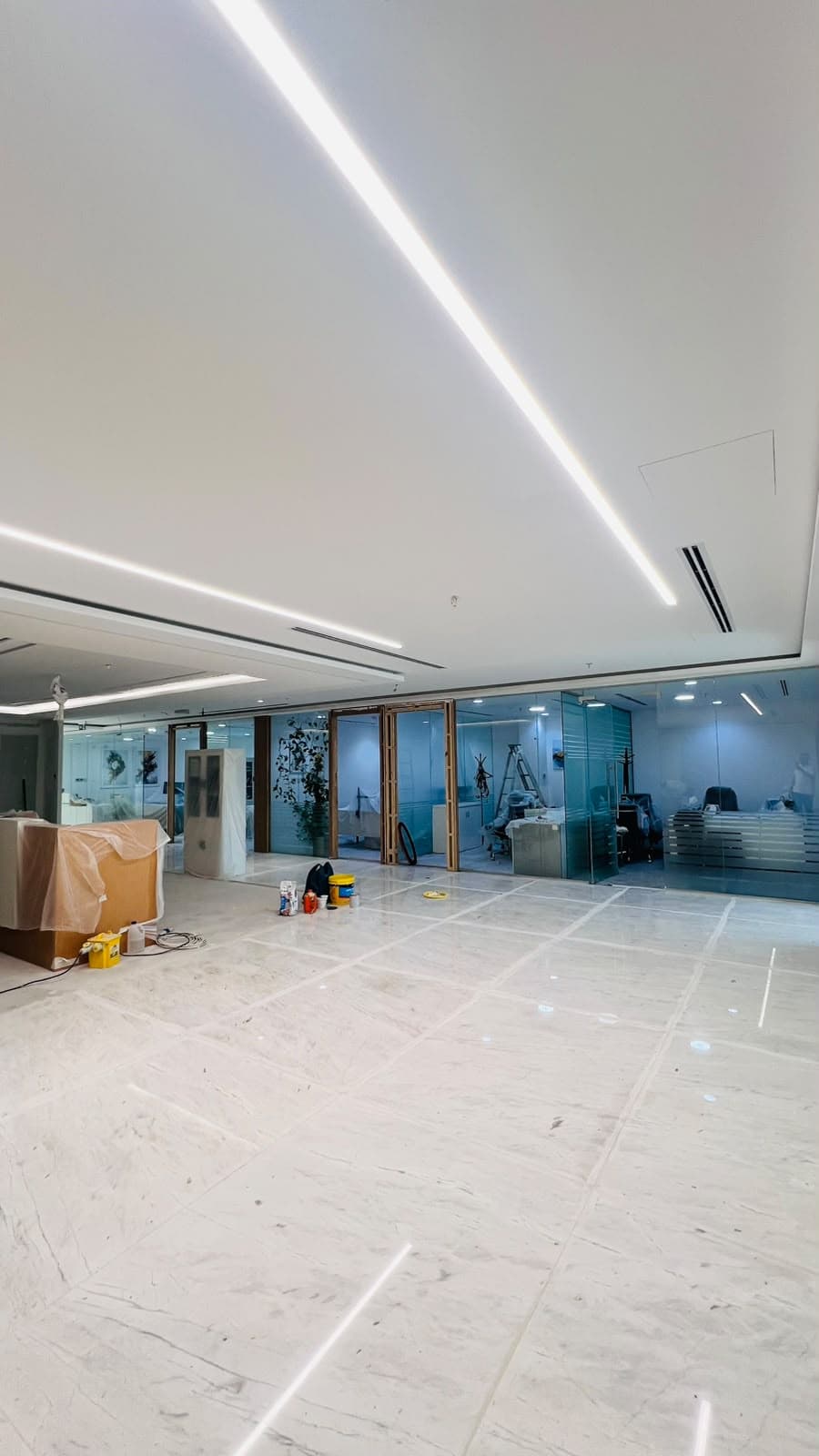
Case Study: Smart Lighting for a Premium Office, Dubai
The problem: a premium office space in Dubai needed a lighting setup that looked clean and modern, but could also be controlled by zone depending on time of day and how each area was being used.
The solution: Mekina's team installed recessed linear LED strip lighting across the main open-plan floor, split into independent zones for the workspace, private glass-walled offices, and reception. Lighting was planned around the ceiling HVAC vents so the whole ceiling reads as one coordinated design.
The result: even, shadow-free lighting with far fewer fixtures than a standard downlight grid, independent dimming per zone, and a coordinated ceiling with no clash between lighting and air conditioning.
The Process We Followed
The office lighting project was completed alongside the broader renovation, coordinated with flooring and partition trades:
- Site walkthrough and lighting zone planning
- Coordination with HVAC layout to avoid ceiling clashes
- Linear LED strip installation across open-plan area
- Zone wiring for independent dimming and control
- Final testing and handover alongside finishing trades
Planning the ceiling as one system — lighting, electrical, and HVAC together — is what avoids the mismatched look of trades working separately.
Thinking about smart lighting for your home or office? Mekina Technical Services handles HVAC, lighting, electrical, home automation, renovation, and waterproofing — all under one team, so your lighting is planned alongside everything else in the ceiling, not around it.
Get in TouchFrequently Asked Questions
Do smart lights use electricity even when they're switched off?
How much extra does this actually add to my bill each month?
Are smart LED bulbs more expensive to run than normal LED bulbs?
Do smart lights save money compared to old incandescent or CFL bulbs?
Does dimming the lights actually make a difference?
Can a badly installed smart lighting system actually cost me more?
Looking for a reliable technical service company in Dubai? Contact Mekina to explore our full range of MEP (HVAC, Electrical and Plumbing), Waterproofing, Automation (Home and Industrial) and facility maintenance solutions.